SC Life Sciences Industry Surges Past $20 Billion
Fastest growth in the Southeast, high-paying jobs and major new investments are positioning South Carolina as an emerging life sciences hub
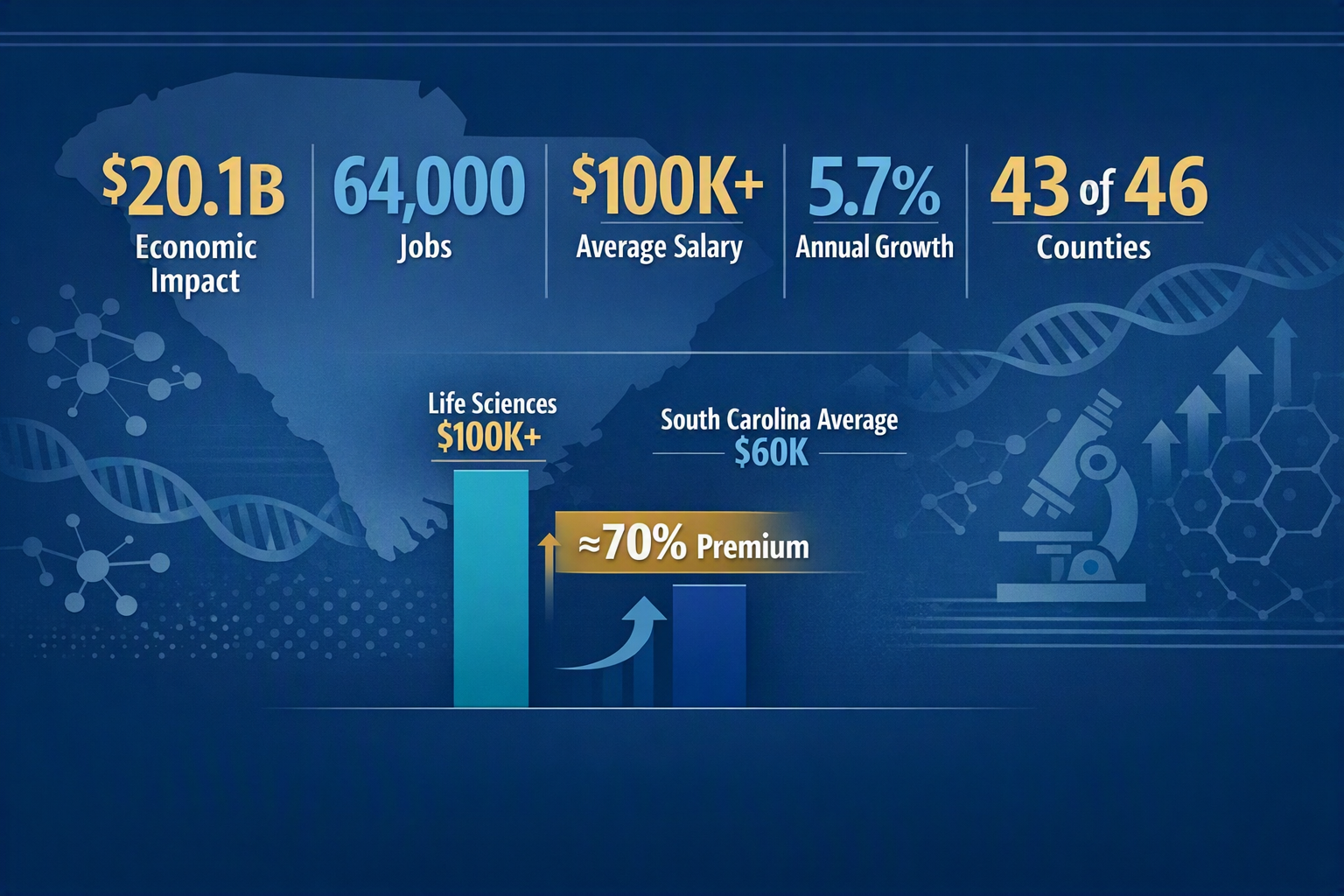
South Carolina’s life sciences industry has grown into a $20.1 billion economic engine, supporting roughly 64,000 jobs across the state and generating average salaries of more than $100,000 a year.
Even more significant is the pace of that growth. South Carolina’s life sciences sector has been the fastest growing in the Southeast, expanding at an annual rate of about 5.7% and outpacing states with longer-established life sciences industries, including North Carolina and Florida.
The numbers reflect an industry that encompasses pharmaceuticals, biotechnology, diagnostics, medical devices and other products and technologies designed to improve or save patients’ lives. And its reach is increasingly statewide, with life sciences activity now present in 43 of South Carolina’s 46 counties.
James Chappell, president and CEO of SCbio, believes the state is only beginning to realize the industry’s potential.
“I think we’re just getting started,” Chappell said. “The same way we think about automotive and aerospace in South Carolina today, that’s the opportunity we have for the life sciences industry in South Carolina.”
Chappell recently joined Let’s Talk Business South Carolina for its Life Sciences Industry Outlook, discussing the sector’s rapid growth, workforce needs and the investments helping establish South Carolina as a larger player in the national life sciences economy.
High-paying jobs fuel the opportunity
One of the industry’s biggest economic benefits is the quality of the jobs it creates. Average annual compensation tops $100,000, compared with approximately $60,000 across South Carolina — a premium of roughly 70%.
Chappell said those salaries reflect the specialized skills required to develop and manufacture products that directly affect patient health and safety.
And those opportunities aren’t limited to scientists with advanced degrees working in laboratories. The industry requires workers across biomanufacturing, quality control, diagnostics, medical device production and numerous other disciplines.
That growing demand also creates one of the industry’s biggest challenges: developing enough workers to keep pace.
SCbio is working with universities, technical colleges and life sciences companies to identify the skills employers need today and those they are likely to need in the future.
The effort begins well before college. SCbio developed Rad Lab, a gaming app designed to introduce middle and high school students to life sciences careers and expose them to jobs they might not otherwise know exist.
Chappell pointed to South Carolina’s technical college system as a significant competitive advantage because of its ability to quickly develop and adapt training programs around employer needs.
Greenville, Charleston emerging as centers
Greenville and Charleston have become two important centers of life sciences activity, supported by university research, entrepreneurship and manufacturing.
In the Upstate, Clemson University and the region’s extensive manufacturing base have helped create opportunities for companies that combine research, advanced materials and manufacturing.
Chappell cited Anderson County-based Poly-Med as an example. The company, which grew out of Clemson research, develops bioresorbable materials used in products such as surgical meshes and scaffolds that can eventually be absorbed by the body.
Charleston, meanwhile, has benefited from university research and the creation of new companies based on that work.
The goal, Chappell said, is to build on those assets and make South Carolina a nationally recognized life sciences hub within the next decade.
Major investments add momentum
Recent economic development announcements provide evidence that South Carolina is gaining attention from major life sciences companies.
Among the most significant is Octapharma’s decision to establish its first U.S. manufacturing operation in York County. The Swiss-based company announced a $1.5 billion investment at the site near Interstate 77.
Octapharma specializes in therapies derived from human plasma proteins that are used to treat conditions including bleeding disorders and immune system deficiencies.
Chappell described the project as a “game-changing” announcement because of both the scale of the investment and what it signals to other global life sciences companies considering South Carolina.
Another recent development brings a very different side of the industry to the state.
G&Q has chosen Greenville for its North American headquarters, bringing technology involving artificial intelligence, quantum computing and high-performance computing to the drug-development process.
Drug development is notoriously expensive and uncertain, with the vast majority of potential drugs failing before reaching patients. Technologies that can better predict whether a drug will succeed — and identify the patients most likely to benefit from it — could dramatically reduce the time and money required to bring new treatments to market.
For South Carolina, attracting both large-scale biomanufacturing and cutting-edge computational life sciences companies demonstrates the breadth of the opportunity.
Chappell said those investments reinforce his belief that South Carolina can establish itself alongside better-known life sciences markets.
“If we’re smart and strategic as a state and all work together, there’s no reason that we shouldn’t be that,” Chappell said. “It’s not a dream. It’s a must.”