South Carolina’s Defense Industry: A $34 Billion Economic Engine Gaining National Recognition
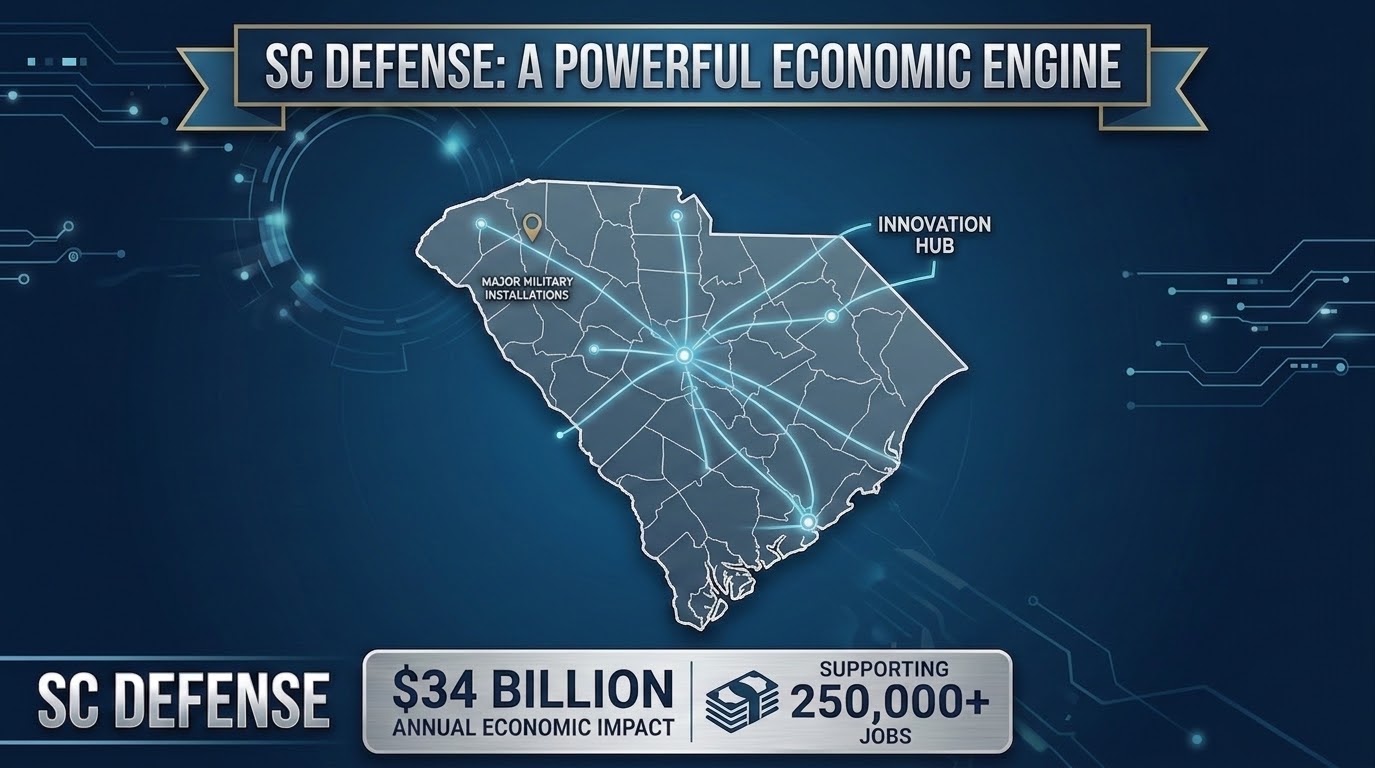
South Carolina’s defense industry has evolved into one of the state’s most important economic drivers, generating an estimated $34 billion in annual economic impact while supporting more than 250,000 jobs across military installations, defense contractors, technology companies and manufacturers.
Yet despite its enormous footprint, much of the industry’s growth has happened quietly.
During a recent episode of Let’s Talk Business South Carolina, Jamie DeMent, Director of SC Tech at the South Carolina Council on Competitiveness, said South Carolina is increasingly being recognized as a national defense hub—one that combines military assets, advanced manufacturing, aerospace, logistics and emerging technologies into a powerful economic engine.
“The defense industry has been here for a very long time,” DeMent said. “It’s just now starting to receive the broader recognition it deserves.”
A Statewide Defense Strategy Takes Shape
Recognizing the industry’s rapid growth, the South Carolina Council on Competitiveness recently launched SC Defense, an initiative designed to strengthen collaboration among military installations, private industry, research organizations and economic development partners throughout the state.
Historically, defense activities have been concentrated within individual regions. SC Defense aims to create a unified statewide strategy that better positions South Carolina to compete for new investment, federal contracts and workforce opportunities.
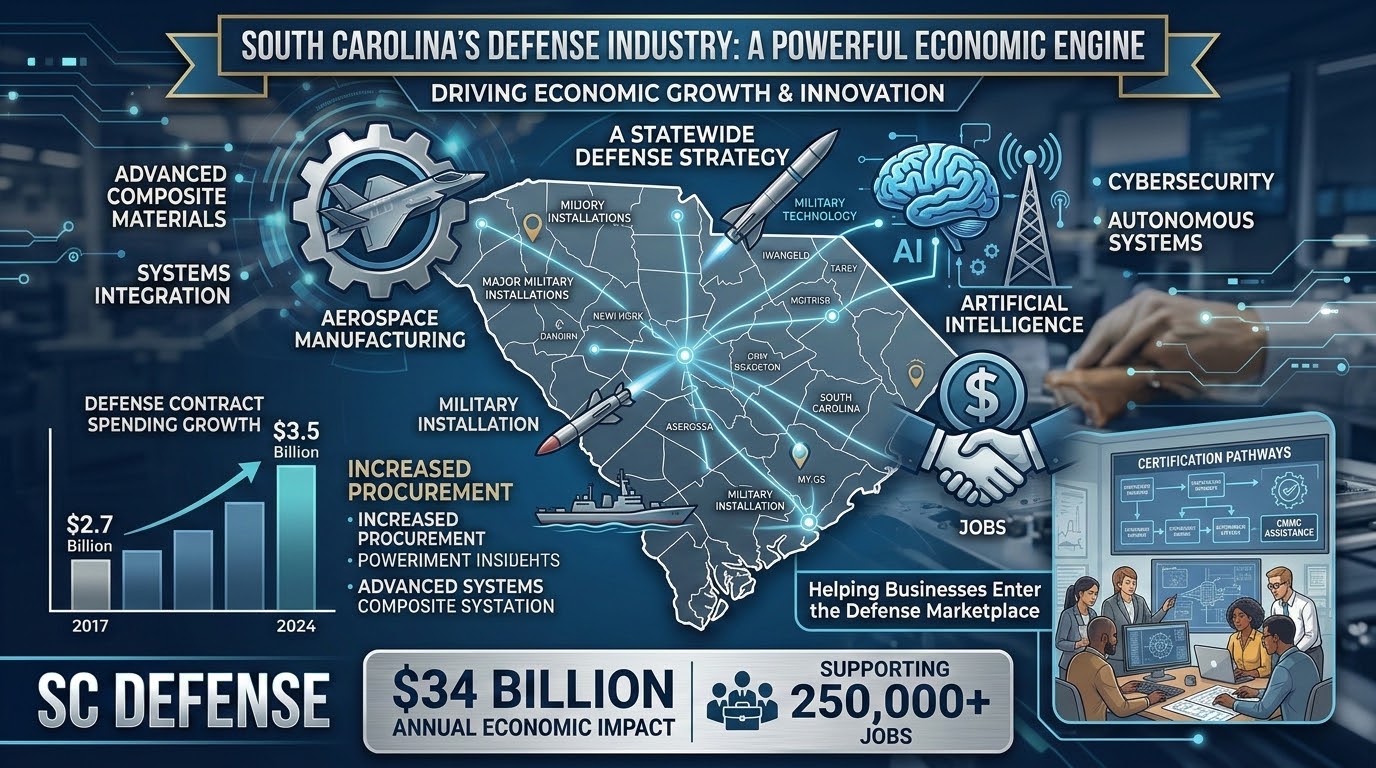
The initiative also builds naturally upon the Council’s long-standing work in aerospace, logistics and technology—industries that increasingly intersect with national defense. Since the initiative’s launch at the 2026 SC Competes Spring Summit, officials have pointed to defense contract spending that grew roughly 30 percent in recent years, from $2.7 billion in 2017 to $3.5 billion in 2024.
More Than Military Bases: South Carolina’s Defense Ecosystem
While South Carolina is home to eight major military installations, DeMent emphasized that the state’s defense economy extends far beyond its bases.
Companies such as Lockheed Martin in Greenville, the Naval Information Warfare Center Atlantic (NIWC Atlantic) in Charleston, Savannah River National Laboratory, and numerous technology, engineering and cybersecurity firms collectively form a robust defense ecosystem.
Many of those organizations support national security through research, software development, communications systems, cybersecurity, advanced manufacturing and logistics.
South Carolina ranks 8th nationally in Department of Defense contract dollars and 10th in DoD personnel, highlighting the state’s growing influence within the defense industry.
Technology Is Reshaping the Defense Industry
Perhaps no force is transforming defense faster than technology.
Artificial intelligence, cybersecurity, autonomous systems, advanced communications and data analytics are fundamentally changing how military organizations operate and how contractors support them. The breakthroughs that brought AI to this point are now arriving on the battlefield and in the back office alike.
“The pace of technology today is incredible,” DeMent noted during the interview. “By the time one conversation is finished, the technology may already have changed.”
That rapid pace is creating opportunities for South Carolina businesses that may not traditionally think of themselves as defense companies.
A software developer, cybersecurity firm or even an HR technology company could possess technology that ultimately finds application within military systems.
Increasingly, the Department of Defense is looking to commercial innovation to accelerate new capabilities for the nation’s warfighters, opening the door for companies well beyond the traditional defense sector.
Helping Businesses Enter the Defense Marketplace
One of SC Defense’s priorities is helping South Carolina companies better understand how to compete in the defense marketplace.
Federal contracting can appear intimidating, particularly for small and mid-sized businesses unfamiliar with military procurement or cybersecurity certification requirements. Commands like NIWC Atlantic publish resources and contract forecasts for industry partners, and small business programs exist specifically to lower the barrier to entry.
The Council hopes to simplify that process by providing education, connections and resources that help companies identify opportunities while navigating evolving requirements such as the Department’s Cybersecurity Maturity Model Certification (CMMC) program.
Those requirements are still in motion. On July 13, 2026, the Department of War announced an immediate suspension of CMMC Phase II requirements—originally scheduled to take effect November 10, 2026—while Phase I self-assessment obligations remain in place, pending a broader review aimed at lowering barriers for small and non-traditional businesses.
The message, DeMent said, is simple: don’t assume your business has nothing to offer the defense industry.
Building Tomorrow’s Defense Workforce
Like virtually every major industry, defense faces significant workforce challenges—the same talent shortages reshaping workplaces across every sector in 2026.
Fortunately, South Carolina possesses several competitive advantages.
Universities across the state continue expanding cybersecurity and technology programs, while the state’s substantial veteran population provides experienced professionals already familiar with military operations and security requirements.
DeMent believes stronger collaboration between higher education, employers and transitioning military personnel will help ensure South Carolina develops the skilled workforce necessary to support continued industry growth.
Looking Ahead: The Next Five Years
Over the next five years, DeMent expects South Carolina’s defense sector to become even more technology-driven.
Artificial intelligence, cybersecurity, drone technologies, advanced manufacturing and rapid commercialization of new technologies are all expected to play increasingly important roles—building on the deep learning breakthroughs that made modern AI possible.
Just as importantly, SC Defense intends to serve as a central resource for companies seeking to enter the defense marketplace while helping existing defense businesses continue to grow.
If successful, South Carolina will strengthen its position as one of the nation’s premier destinations for defense innovation, manufacturing and technology.
For business leaders, entrepreneurs and manufacturers alike, the defense industry represents far more than military spending. It is becoming one of South Carolina’s fastest-growing opportunities for innovation, investment and long-term economic growth.